

1. The Invisible Shield: What Cryptography Is and Why It Rules Our Digital Lives
Every single second, billions of encrypted byte strings zip across global fiber-optic cables, cellular towers, and cloud datacenters. Whether you are checking your bank balance, sending a private chat to a colleague, or logging into a corporate cloud server, an invisible shield works endlessly behind the scenes to defend that information. That shield is cryptography.
In plain terms, cryptography is the mathematical foundation of modern digital trust. It guarantees three non-negotiable security requirements across our connected world: confidentiality (keeping private data hidden from prying eyes), integrity (guaranteeing that data has not been altered or tampered with during transmission), and authenticity (verifying that the person, device, or server on the other end is genuinely who they claim to be).
Without cryptography, the modern internet would immediately cease to function as a medium for business or private communication. Modern digital life relies on these mathematical safeguards across 5 Key Real-World Applications:
- HTTPS Web Browsing: Encrypting transactions, passwords, and sensitive web traffic moving across public internet channels to secure global e-commerce and daily web browsing.
- Wi-Fi Access: Protecting wireless network credentials and data packets from local eavesdroppers and unauthorized network intruders.
- Online Banking & ATMs: Securing high-value financial data transfers, PIN numbers, and identity verification across global banking networks and payment gateways.
- Messaging & Communication: Safeguarding private corporate emails and chat messages across communications platforms like Microsoft Teams and Outlook.
- Cloud Storage & Enterprise Systems: Defending stored files, proprietary databases, and enterprise applications moving across cloud infrastructure like OneDrive and Azure datacenters.
Core Takeaway: Cryptography is not an obscure technical add-on for IT departments; it is the invisible pillar holding up global commerce, privacy, and digital trust. If modern encryption were suddenly broken, enterprise operations, online banking, and personal privacy would instantly collapse.
Understanding why modern digital life depends so heavily on this invisible shield requires taking a closer look at the specific mathematical mechanisms that make today’s encryption algorithms work.
2. The Two Pillars of Modern Cryptography: Public-Key vs. Symmetric-Key
Modern digital security relies on a balance between two distinct cryptographic pillars: Public-Key (Asymmetric) Cryptography and Symmetric-Key Cryptography. Each performs a specialized role in protecting digital interactions.
+-----------------------------------------------------------------------+
|                       MODERN CRYPTOGRAPHY                             |
+-----------------------------------+-----------------------------------+
|     PUBLIC-KEY (ASYMMETRIC)       |          SYMMETRIC-KEY            |
|  - Encapsulation & Decapsulation  |  - Uses One Shared Secret Key     |
|  - Creates "Trapdoor" Math        |  - Fast High-Volume Data Storage  |
|  - RSA, ECC (Quantum-Vulnerable)  |  - AES-256 (Quantum-Safe)         |
+-----------------------------------+-----------------------------------+
Public-Key Cryptography (Asymmetric)
Public-key encryption relies on a mathematically paired set of keys: an encapsulation/public key that can be freely shared across open networks, and a matching decapsulation/private key kept strictly secret by its owner.
Think of public-key cryptography as a specialized mathematical “trapdoor.” Anyone can use your public key to snap a padlock shut (encrypt a payload or verify a digital signature). However, once that trapdoor snaps shut, only the holder of the matching private decapsulation key can open it (decrypt the data or generate a signature). Today’s web connections rely on public-key algorithms like RSA (Integer Factorization) and Elliptic Curve Cryptography (ECC) to establish initial trust and establish identity over untrusted channels.
NIST Terminology Note (FIPS 203 Mandate): To eliminate ambiguity in modern post-quantum standards, the National Institute of Standards and Technology (NIST) explicitly drops generic legacy terms like “public key” and “private key” in FIPS 203. Instead, keys are defined by their exact mathematical function: encapsulation key, decapsulation key, encryption key, decryption key, and shared secret key.
Symmetric-Key Cryptography (Shared Secret)
Unlike asymmetric systems, symmetric-key cryptography uses a single shared secret key to both encrypt and decrypt data. Because symmetric algorithms do not require complex trapdoor math, ciphers like AES-256 are blazingly fast and highly efficient for encrypting massive volumes of data at rest or in transit—from ATM cash withdrawals to high-speed datacenter replication.
The 2-column table below contrasts how these two cryptographic pillars operate across modern systems:
| Evaluation Criterion | Public-Key (Asymmetric) vs. Symmetric-Key Cryptography |
| Primary Purpose | Public-Key: Securing initial key exchanges over untrusted public networks and authenticating identity via digital signatures. Symmetric-Key: Encrypting high-volume data storage (data at rest) and high-speed data transmission (data in transit). |
| Key Structure | Public-Key: Asymmetric key pair (public/encapsulation key shared openly; private/decapsulation key kept strictly secret). Symmetric-Key: Single shared secret key shared privately between authorized communicating parties. |
| Mathematical Basis | Public-Key: “Trapdoor” mathematical problems based on factoring large prime numbers (RSA) or discrete logarithms (ECC). Symmetric-Key: Complex substitution, permutation, and hashing functions (e.g., AES-256, SHA-256). |
| Quantum Threat Level | Public-Key (High Threat): Catastrophically broken by scaled quantum computers running Shor’s algorithm. Symmetric-Key (Quantum-Safe): Highly resistant; breaking AES-256 with a quantum computer would take over 7 billion centuries. |
While both cryptographic pillars are vital to daily internet operations, the arrival of quantum computing impacts these two foundational structures in radically different ways.
3. Enter Quantum Computing: Breaking the Unbreakable Math
To understand the quantum threat, it helps to contrast traditional supercomputers with quantum computers. Classical computers process information using standard bits represented as 0s or 1s. To break a public-key algorithm like RSA or ECC, a classical supercomputer must test possibilities using brute force or slow mathematical tricks—a process that would require thousands of years of continuous computation.
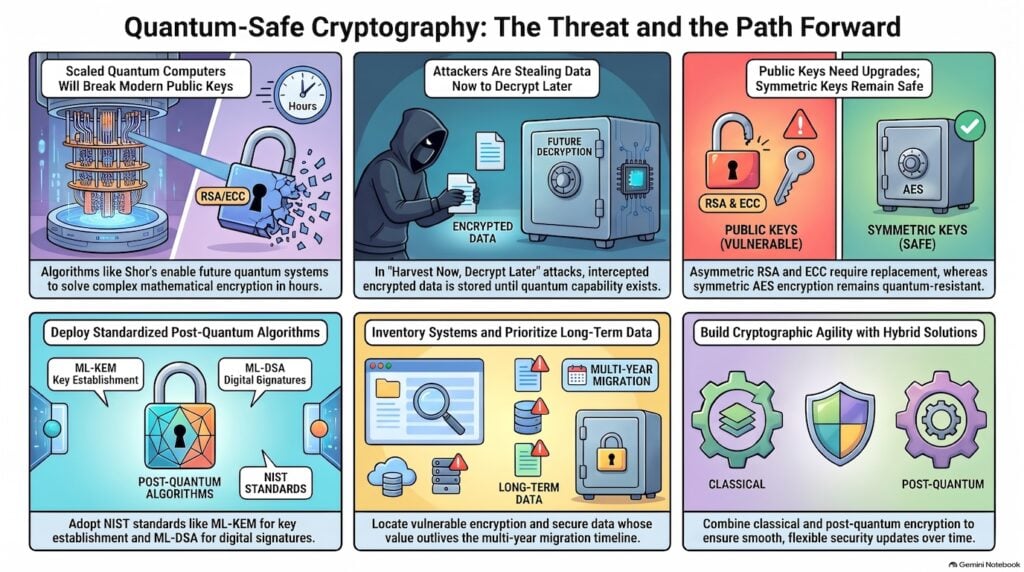
Quantum computers, however, leverage quantum mechanical principles such as superposition and entanglement. Rather than relying on classical brute force, a scaled quantum computer running Shor’s Algorithm can solve the “trapdoor” math of public-key cryptography—specifically factoring large prime numbers and calculating discrete logarithms—in just a few hours.
CLASSICAL SUPERCOMPUTER                        SCALED QUANTUM COMPUTER
  [0101010010101]                                 [|Ψ⟩ = α|0⟩ + β|1⟩]
  Brute-Forcing Public-Key Math                  Running Shor's Algorithm
  Time Required: Thousands of Years               Time Required: A Few Hours
⚠️ WARNING: The Impossible Math Made Possible A cryptographically relevant quantum computer running Shor’s Algorithm completely dismantles the “trapdoor” math of classical public-key encryption. By calculating a decapsulation (private) key directly from its public encapsulation key in a few hours, a quantum adversary can open asymmetric encryption from both sides.
The Divergence: Asymmetric Collapse vs. Symmetric Resilience
This mathematical breakthrough creates a sharp divide across digital security:
- Public-Key Algorithms Collapse Completely: RSA, ECC, and Diffie-Hellman offer zero mathematical protection once scaled quantum hardware becomes operational.
- Symmetric Algorithms Remain Quantum-Safe: Symmetric ciphers like AES-256 do not rely on integer factorization or discrete logarithms. A scaled quantum computer running Grover’s algorithm only reduces symmetric key strength by half, meaning AES-256 still takes over 7 billion centuries to brute-force—leaving symmetric encryption fundamentally quantum-safe.
Because asymmetric algorithms are used to lock down initial web connections, verify device identities, and issue security certificates, their vulnerability creates an immediate operational danger long before physical quantum supercomputers become widespread.
4. The Ticking Clock: Q-Day and “Harvest Now, Decrypt Later” (HNDL)
In cybersecurity, Q-Day (or Y2Q) defines the future point in time when scaled, cryptographically relevant quantum computers become operational and capable of breaking classical public-key algorithms.
While Q-Day itself may still be years away, threat actors are not waiting for quantum hardware to be finalized. Instead, state-sponsored entities and cybercriminals are actively executing a strategy known as Harvest Now, Decrypt Later (HNDL).
       TODAY (Pre-Q-Day)                            FUTURE (Q-Day)
+-----------------------------+              +-----------------------------+
| Threat Actors Intercept &   |              | Scaled Quantum Computer     |
| Steal Encrypted Traffic     | ============>| Runs Shor's Algorithm       |
| (IP, Health Records,        |  Stored Data | Retroactively Decrypts      |
| Financial Archives)         |              | All Intercepted Data        |
+-----------------------------+              +-----------------------------+
Under an HNDL attack, bad actors silently intercept and store massive volumes of encrypted internet traffic passing across public networks today. They archive this unreadable data in storage facilities. Once Q-Day arrives, they will execute Shor’s algorithm on a quantum computer to break the original asymmetric key exchanges, compute the historic secret keys, and retroactively decrypt all stored communications.
The Data Relevance Principle
Not all enterprise data retains long-term value. A credit card authorization token might expire in minutes, and an online session key expires in hours. However, high-value organizational data—such as trade secrets, strategic acquisition plans, lifelong medical records, defense intellectual property, and industrial blueprints—remains confidential for decades.
Under the Data Relevance Principle, if sensitive data has a 10-year secrecy requirement, and a cryptographically relevant quantum computer arrives in 7 years, that data is already compromised today if harvested in an HNDL attack.
3 Reasons Why HNDL Requires Immediate Action
- Data Shelf Life Outlasts Quantum Development: Corporate secrets and personal data stolen today will retain tremendous espionage and economic value when quantum decryption capabilities go online.
- Cryptographic Migration Takes Years: Upgrading hardware, software protocols, cloud architectures, and supply chain integrations across an enterprise requires a multi-year effort.
- Encrypted Interception Is Happening Right Now: HNDL is not a theoretical scenario; bad actors are actively intercepting and archiving encrypted enterprise network traffic today.
To neutralize the active threat of HNDL attacks, international standards bodies have officially published a new suite of post-quantum defenses.
5. The New Defense: NIST Post-Quantum Standards (ML-KEM & ML-DSA)
On August 13, 2024, the National Institute of Standards and Technology (NIST) released its finalized Post-Quantum Cryptography (PQC) standards. These standards replace vulnerable RSA and ECC algorithms with quantum-resistant mathematics known as Module-Lattice-Based Cryptography.
Demystifying Lattice Mathematics
To conceptualize lattice cryptography, contrast classical public-key math with lattice math:
- Classical Math (Prime Factorization / Discrete Logarithms): Relies on single-variable arithmetic—similar to finding two specific prime numbers that multiply together to yield a target product. Shor’s algorithm solves this easily by analyzing mathematical periodicity.
- Lattice Math (High-Dimensional Geometric Grids): Relies on the complexity of calculating specific points in massive, multi-dimensional geometric grid structures (lattices) intentionally obscured with random mathematical “noise” (Module Learning With Errors / MLWE). Finding the secret point is like trying to pinpoint a specific intersection inside a thousand-dimensional grid hidden behind heavy static noise. This problem is computationally intractable for both classical supercomputers and quantum computers running Shor’s algorithm.
NIST’s finalized PQC suite features two flagship standards specified under Federal Information Processing Standards (FIPS):
1. ML-KEM (FIPS 203 – Module-Lattice-Based Key-Encapsulation Mechanism)
- Derived From: CRYSTALS-Kyber.
- Primary Security Function: Secures key establishment over public channels. ML-KEM enables two parties to establish a 256-bit shared secret key securely, which is then used with symmetric encryption (like AES-256) to protect high-volume data transfers.
- Approved Parameter Sets:
ML-KEM-512(NIST Security Category 1 – 128-bit quantum strength)ML-KEM-768(NIST Security Category 3 – 192-bit quantum strength) — NIST’s Recommended DefaultML-KEM-1024(NIST Security Category 5 – 256-bit quantum strength)
- Recommended Usage: NIST recommends ML-KEM-768 as the universal default for general applications, offering high security margins at excellent operational speeds.
2. ML-DSA (FIPS 204 – Module-Lattice-Based Digital Signature Standard)
- Derived From: CRYSTALS-Dilithium.
- Underlying Mathematical Foundation: Based on the computational hardness of the Module Learning With Errors (MLWE) and Module Short Integer Solution (MSIS) problems on lattice structures.
- Primary Security Function: Generates and verifies digital signatures to guarantee data integrity, origin authentication, and non-repudiation (preventing a signatory from falsely denying their signature).
- Role in Digital Trust Architectures: Serves as the core engine for Public Key Infrastructure (PKI), authenticating identity certificates (X.509), securing electronic mail, validating digital code signatures, and securing software updates.
| Standard Feature | ML-KEM | ML-DSA |
| FIPS Publication | FIPS 203 | FIPS 204 |
| Derived From | CRYSTALS-Kyber | CRYSTALS-Dilithium |
| Primary Security Function | Key Establishment & Encapsulation (Securing shared secret keys over public channels). | Digital Signatures (Authenticating identity, verifying data integrity, and enforcing non-repudiation). |
| Recommended Usage | General key exchange across networks, cloud services, and software (ML-KEM-768 default). | Public-Key Infrastructure (PKI), digital identity certificates, code signing, and secure email. |
With these standards finalized, small and medium-sized businesses (SMBs) must now execute practical migration plans.
6. Action Plan for SMBs: 5 Steps to Prepare Your Business Today
Migrating to post-quantum security requires deliberate organizational planning. Small and Medium Businesses (SMBs) cannot afford to wait until Q-Day to modernize their security architectures. Based on guidelines from NIST and the National Cybersecurity Center of Excellence (NCCoE), here is a prioritized, 5-step migration blueprint:
+-------------------------------------------------------------------+
|                  SMB POST-QUANTUM MIGRATION ROADMAP               |
+-------------------------------------------------------------------+
| 1. CONDUCT A CRYPTOGRAPHIC INVENTORY (DISCOVERY)                  |
| 2. ASSESS HIGH-RISK DATA & PRIORITIZE RISK                        |
| 3. ADOPT NIST POST-QUANTUM STANDARDS                              |
| 4. DEMAND CRYPTO AGILITY FROM TECH VENDORS                        |
| 5. ESTABLISH MIGRATION TIMELINES & TEST INTEROPERABILITY          |
+-------------------------------------------------------------------+
Step 1: Conduct a Cryptographic Inventory (Discovery)
You cannot protect assets you have not identified. Deploy automated discovery tools across your infrastructure to audit where classical, quantum-vulnerable public-key algorithms (RSA, ECC, Diffie-Hellman) are currently used in hardware, operating systems, cloud applications, web servers, and third-party SaaS connections.
Step 2: Assess High-Risk Data & Prioritize Risk
Evaluate organizational data against a 10-year retention horizon. Identify proprietary intellectual property, strategic planning documents, legal archives, and sensitive customer data exposed to “Harvest Now, Decrypt Later” (HNDL) attacks. Prioritize systems hosting or transmitting these long-term data assets for immediate PQC migration.
Step 3: Adopt NIST Post-Quantum Standards
Begin replacing vulnerable asymmetric schemes with standardized NIST algorithms. Integrate ML-KEM (FIPS 203) for secure key establishment and key encapsulation, and deploy ML-DSA (FIPS 204) for identity verification, PKI certificate issuing, and code signing.
Step 4: Demand Crypto Agility from Tech Vendors
Ensure enterprise hardware, software, and cloud suppliers support crypto agility—the modular ability to update or swap cryptographic algorithms and key sizes without breaking underlying software infrastructure.
When issuing RFPs or reviewing vendor contract renewals, insert concrete procurement directives such as:
“Does your product architecture support modular algorithm replacement under NIST FIPS 203 (ML-KEM) and FIPS 204 (ML-DSA) standards without requiring core database or application re-architecture?”
“What is your published product roadmap for replacing legacy RSA and ECC certificates with NIST-standardized PQC algorithms across all hosted and managed services?”
Step 5: Establish Migration Timelines & Test Interoperability
Build a structured migration timeline with firm operational milestones. Following NCCoE guidelines, conduct extensive interoperability testing within controlled, non-production environments before deploying PQC algorithms to live systems.
Why Non-Production Staging Is Critical: Post-quantum lattice algorithms require significantly larger key sizes and ciphertexts than legacy RSA or ECC systems. For example, an ML-KEM-768 encapsulation key is 1,184 bytes, compared to an RSA-2048 key at ~256 bytes. This sudden increase in data payload size can trigger network packet fragmentation, buffer overruns, or unexpected latency in legacy firewalls, routers, and custom software. Staging allows IT teams to identify and remediate packet loss and performance bottlenecks safely without disrupting active business operations.
Your Post-Quantum Readiness Checklist
Use this executive summary checklist to review your organization’s post-quantum posture today:
- [ ] Audit Cryptographic Inventory: Have we deployed automated discovery tools to locate all RSA and ECC algorithms across enterprise applications, hardware, and cloud hosts?
- [ ] Flag HNDL Vulnerabilities: Have we identified high-value data assets with a 10-year secrecy requirement that are currently vulnerable to “Harvest Now, Decrypt Later” interception?
- [ ] Verify Vendor PQC Roadmaps: Have we queried our primary cloud, IT, and software vendors regarding their compliance timelines for NIST FIPS 203 (ML-KEM) and FIPS 204 (ML-DSA)?
- [ ] Enforce Crypto Agility in RFPs: Do our procurement requirements mandate that new software and infrastructure support flexible algorithm swapping without breaking system logic?
- [ ] Establish Non-Production Testing Staging: Have we set up non-production test environments to check PQC payload overhead, key size compatibility, and network performance prior to live production deployment?